
It’s not difficult!
My yoke is easy and my burden is light. (Matthew 11:30)
Most people in the UK and around the world believe that climate change and other environmental issues are serious problems that need to be faced. However, this is not always translated into practical lifestyle actions. Often people are not sure what they can do or feel that it is all much too difficult.
Here are some examples of how Gateway members have made helpful personal changes that could be followed by others. What comes out is that helping the planet also helps us. And it’s not difficult!
Eating less meat
Across the world, the meat industry brings numerous problems, including massive deforestation and increasing carbon emissions that drive climate change. In the developed world, eating excessive meat is a significant health threat.
While the Bible does not require us to follow a vegetarian or vegan diet[1], for many people eating less meat will save money and bring long-term health benefits, as well as helping to protect the earth. Esther Bissell writes:
Whilst not a huge meat eater, I was shocked to discover the carbon impact of animals. I wanted to do something about this and lower my carbon impact on creation.
Having discussed various options for our household, I decided to take a more mindful approach to consuming animal produce, eating fewer animal products, but I didn't want to cut them out completely.
I've really enjoyed creatively considering recipes and meals, replacing the animal component with beans or lentils. I've discovered beans are a lot more than just the Heinz kind!

Beans come in all different forms - my current favourites being chickpeas and butter beans! They are a great source of protein, other vitamins, minerals and fibre, are great soakers up of flavour, and are economical too!
I have begun using my pressure cooker to reduce cost further, using dried, rather than canned beans- it speeds up an overnight soak, plus boiling time, to 3-40 minutes.
I'm looking forward to more bean adventures to come!
Dealing with Litter
Litter is a huge problem. It causes environmental damage and impacts human health and safety. Though we can’t easily change everyone’s behaviour, individuals can do something about it. Adrian Dewar writes:
I love walking! Almost every day I walk to my local shops and occasionally I walk around my local park. Recently I’ve noticed there are often a lot of empty beer and wine bottles left at the side of footpaths and in various locations in the park. So, I decided to do a bit of tidying up and recycling at the same time: on several occasions I’ve gone out with an empty bag and picked up any bottles I’ve seen on my way to the shops. I’ve also retrieved any bottles I’ve seen in the park. I’ve then cleaned them up and popped them into my green recycling bin. I picked up these one morning recently:
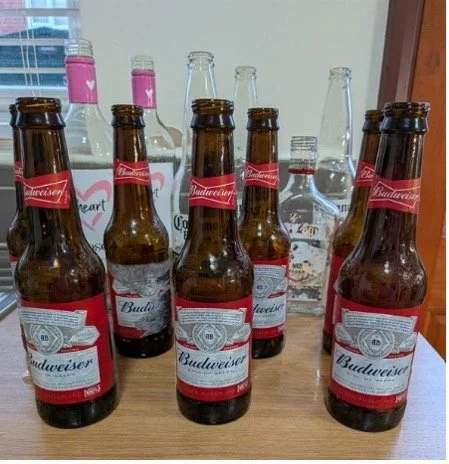
It only took about half an hour and who knows what they might become? Kitchenware, insulation, jewellery or new bottles and jars. One thing is for sure: they’ll get a second breath of life. After all, even bottles aspire to be something!
Adrian’s actions are not difficult! They don’t just help to keep our streets tidy, but they speak of a God who restores even what has been lost or discarded and is always bringing fresh hope and new opportunities.
Careful computer use
It may not be obvious, but the way we use our computers can affect our environment through electricity and water consumption, especially when using the latest AI tools.
Mahesh Peddapeta is a research student who makes heavy use of computers in his daily work. He writes:
A few small steps I’ve been trying to take are mostly around reducing energy and resource use in everyday academic life.
1. I avoid leaving my computer running unless simulations are actively running, rather than keeping it on by default. This reduces power consumption.
2. As a research group, we also made a New Year’s resolution to reduce unnecessary printing, paper usage and move more of our reviewing and note-taking online.
3. I’ve also been trying to use generative AI tools more consciously, avoiding unnecessary prompts or repetitive tasks that consume energy and water without real benefit.

Mahesh shows that while many of us will inevitably take more from the environment than we would like, we can still be mindful of our responsibility, as those created in God’s image to care for his world. Our daily actions matter for the earth. By using less, we can save ourselves money. Best of all, whether in small ways or large, we can express our worship to God by caring for his good creation.
[1] For example, Mark 7:18-19; Romans 14:1-4; 1 Timothy 4:4.